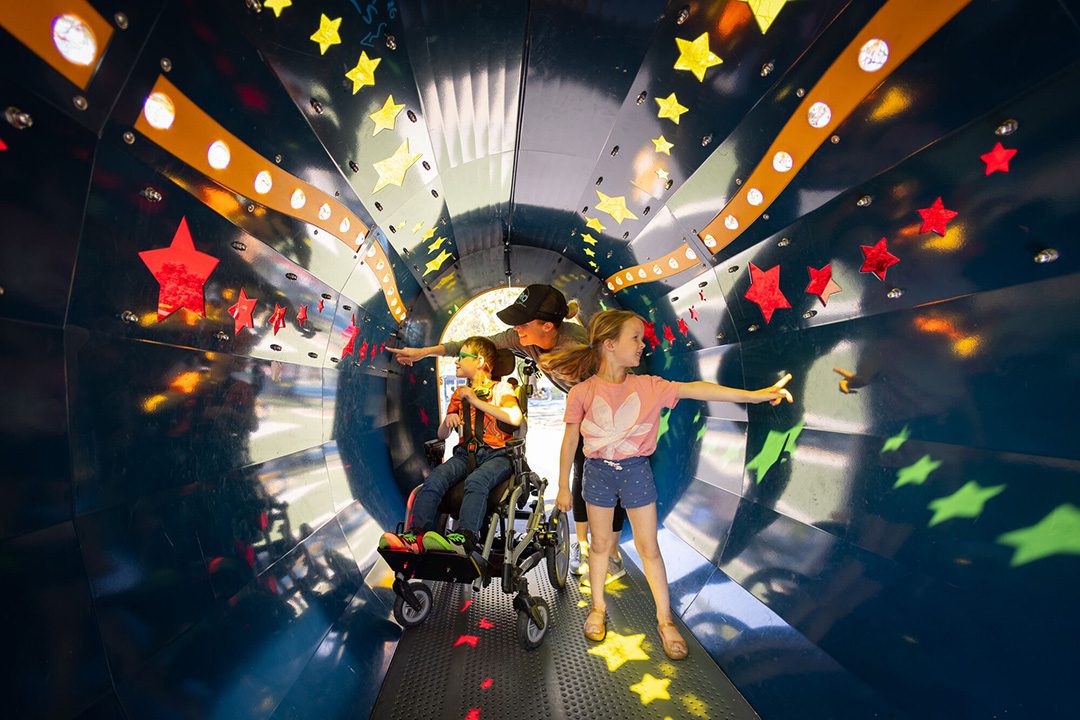
At the Park Circle Playground in North Charleston, South Carolina, kids can explore a sensory tunnel full of colors, lights, and textures, wide enough for a wheelchair and stimulating yet calming.
This sensory tunnel is part of the world’s largest inclusive playground, a place where people of all abilities and ages can be engaged, challenged, and entertained in ways that meet their needs.
The Americans with Disabilities Act’s 2010 Standards for Accessible Design created a baseline mandate for playground accessibility. But inclusivity is a concept that goes much further. And creating inclusive parks is a growing movement that Landscape Structures fosters with playground products like the sensory tunnel, the We-Go-Round®, a next-generation inclusive merry-go-round, and a plethora of climbing, sliding, spinning, swinging, and learning components.
“The power of inclusive design is that we all feel welcome,” said Jill Moore, an inclusive play specialist at Landscape Structures, a Delano, Minnesota-based commercial playground equipment designer and manufacturer. A wheelchair user, she feels strongly about the concept of “nothing about us without us.”
Landscape Structures develops all its products in conversation with communities, and tests the products with kids playing on them and giving feedback.
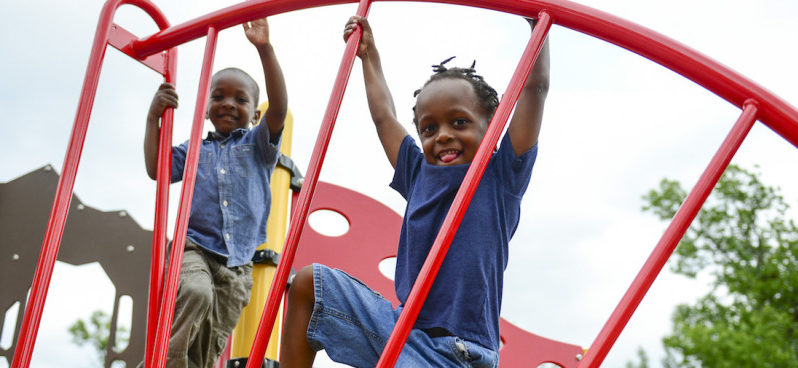
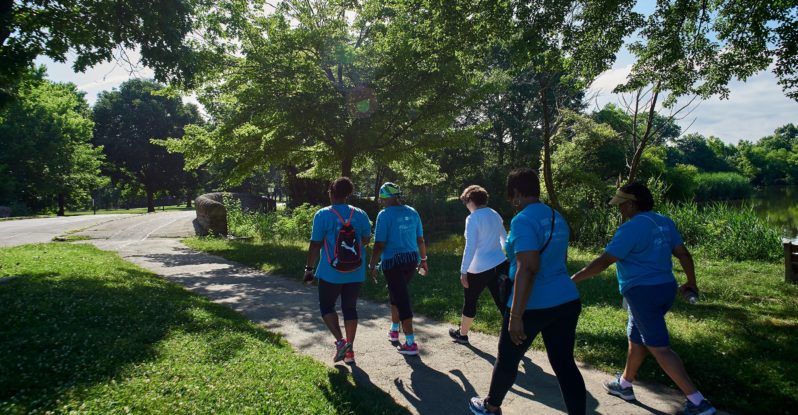
Nationwide, inclusive parks have been a boon for families and communities. They’ve provided a boost for local businesses, given residents of all ages a place to gather, and allowed kids of all abilities to play safely and comfortably, in spaces that are neither separate nor marginalized.
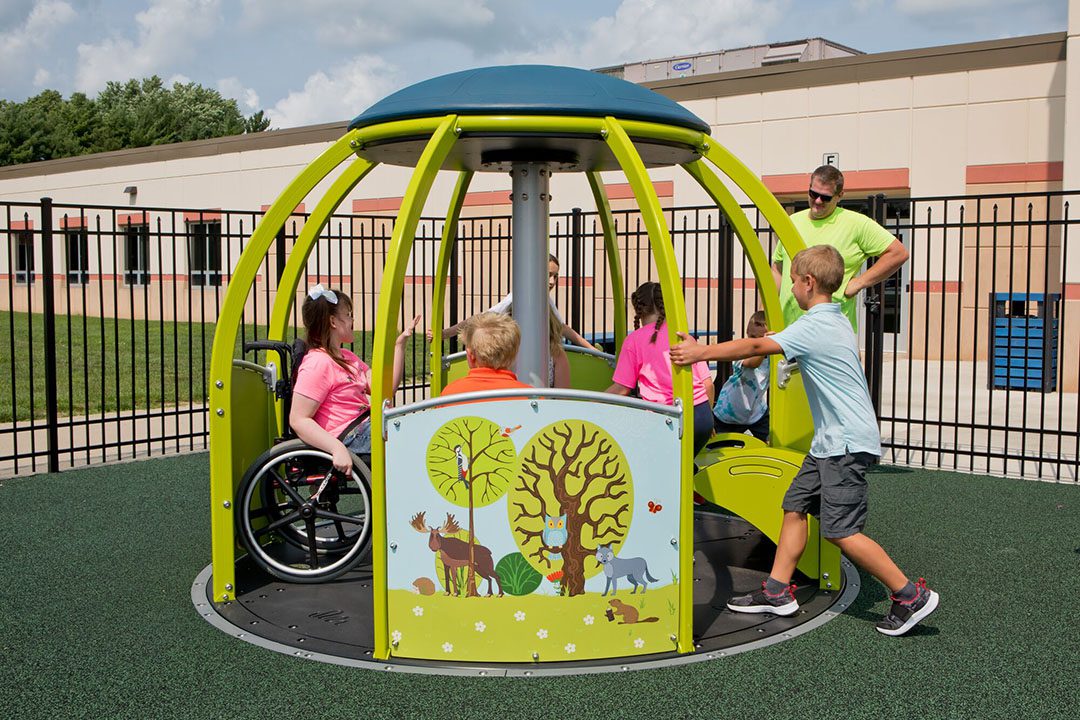
“Growing up, I was at the mercy of people doing things to me or for me,” Moore explains. Inclusive play spaces change that — for example, by offering climbing structures with various routes that allow people of varying abilities to make their own way to the top, or merry-go-rounds that wheelchair users can get on and off easily.
“Inclusive playground design is about providing our users the power to choose. All these little things add up and allow people with physical disabilities to control their environment,” Moore says. “We talk a lot about autonomy and empowerment in the play space.”
Inclusive play spaces have “something for everyone,” she continues. “Not just for kids with disabilities, but for every single kid. We all need something to help us be our best selves.”
For playground users with autism or other sensitivity to overstimulation, it’s important to have quiet areas and places where they can explore without being overwhelmed. Swings can have a calming effect, as can shady nooks under playground decks, or log tunnels. “Before, the buzzword was ‘sensory rich,’ which generally meant bells, whistles, lights, and sound, all together,” said Ariel Mansholt, OTD, OTR/L, CPSI, a Landscape Structures inclusive play specialist and pediatric and adolescent occupational therapist. “That kind of environment is super overwhelming. It’s not a sensory-friendly place. We like to practice sensory diversity.”
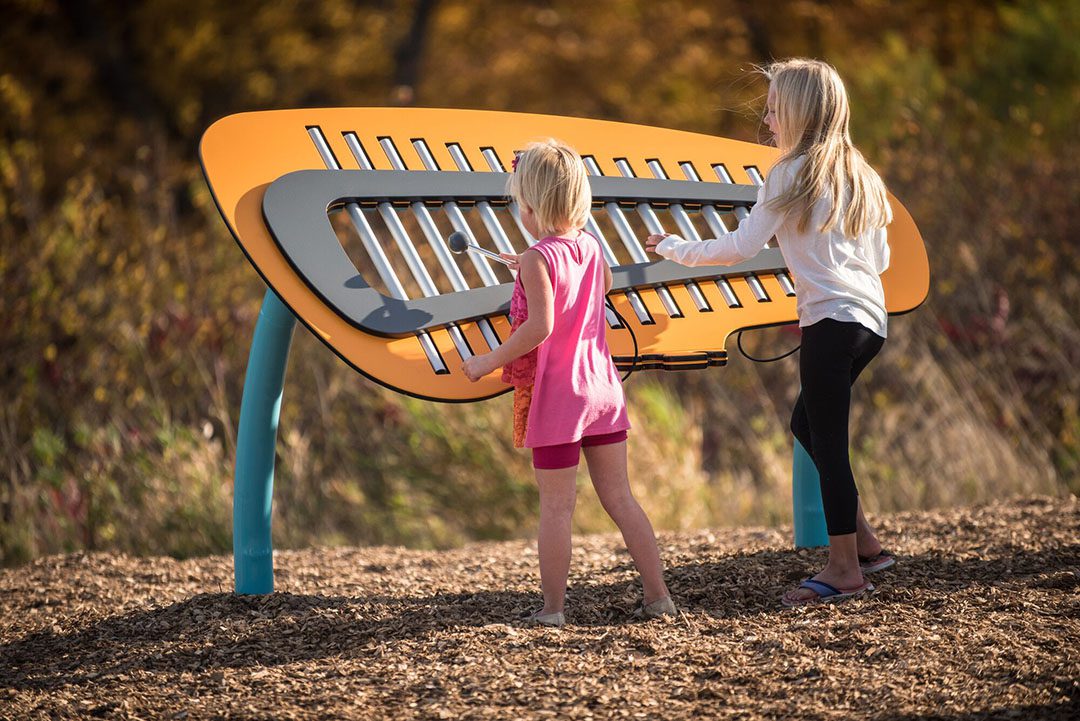
Outdoor musical instruments, “fossil digs,” and sand tables are other pieces of equipment that let kids use their senses and curiosity without being overstimulated.
Hana Ishikawa is a landscape architect at the firm Site Design, which often selects Landscape Structures products for the parks it designs. She notes that it’s crucial not to segment off areas — as in, “‘This is the wheelchair area’ or ‘this is the area that only kids hard of hearing can sit in.’ It all has to be integrated, so that you can’t tell what kind of area is meant for whom.”
As Ishikawa describes it, “Playgrounds are meant to challenge you continuously,” whatever your ability levels and needs. “They’re not meant to exist in a padded room. They’re meant to encourage discovery and even carry a sense of risk. The whole point of playgrounds is that they let kids build the capacity to do something today that they couldn’t do yesterday.”
Cities and towns are increasingly seeking inclusive play spaces, and using Landscape Structures’ products in them.
Anchorage, Alaska, committed to making its parks inclusive, and surveyed all parks, scoring them and cross-referencing their attributes with the specific needs of the local community. The city now has a map of a dozen inclusive playgrounds, and visitors can receive a Moose Loop sticker for visiting them all.
In St. Paul, Minnesota, the inclusive playground PK’s Place provides key access to recreation and nature for a diverse community, including Somali and Hmong families. The park was funded in part by professional soccer team Minnesota United FC, whose Allianz Field sits nearby.
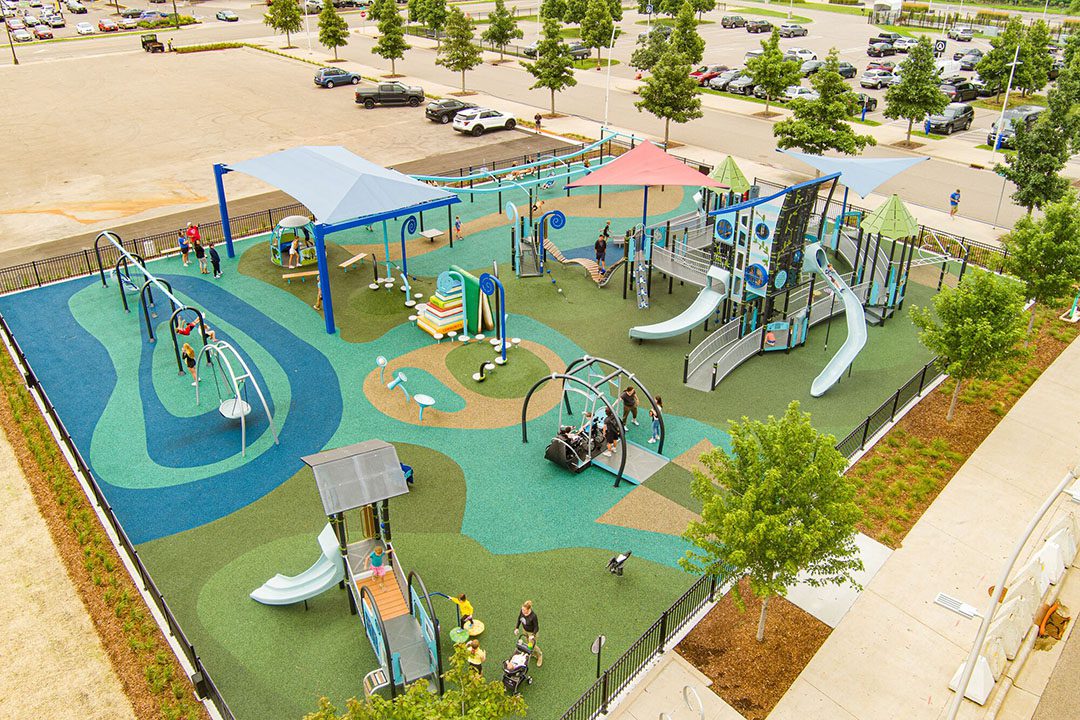
PK’s Place, St Paul, MN
In Chicago, former factory sites became Park 596, where a springy rubberized tunnel bridge, a twisty slide, a funnel-shaped net, and a rubberized wheelchair transfer station all allow multiple ways to climb, explore, and become “King of the Hill” on a central apex.
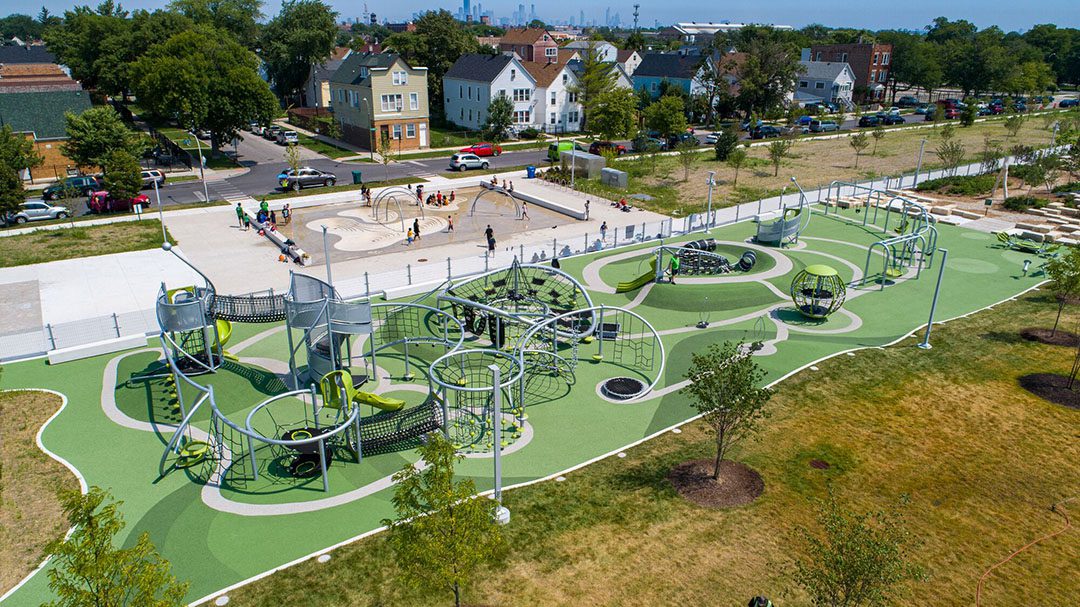
Park 596, Chicago, IL
In Altadena, California, the Loma Alta Park reopened as an inclusive play space four months after the devastating wildfires of early 2025. New inclusive play structures replaced equipment burned and melted in the fires, and facilities that include a coffee island and computer lab appeal to senior citizens and other adults.
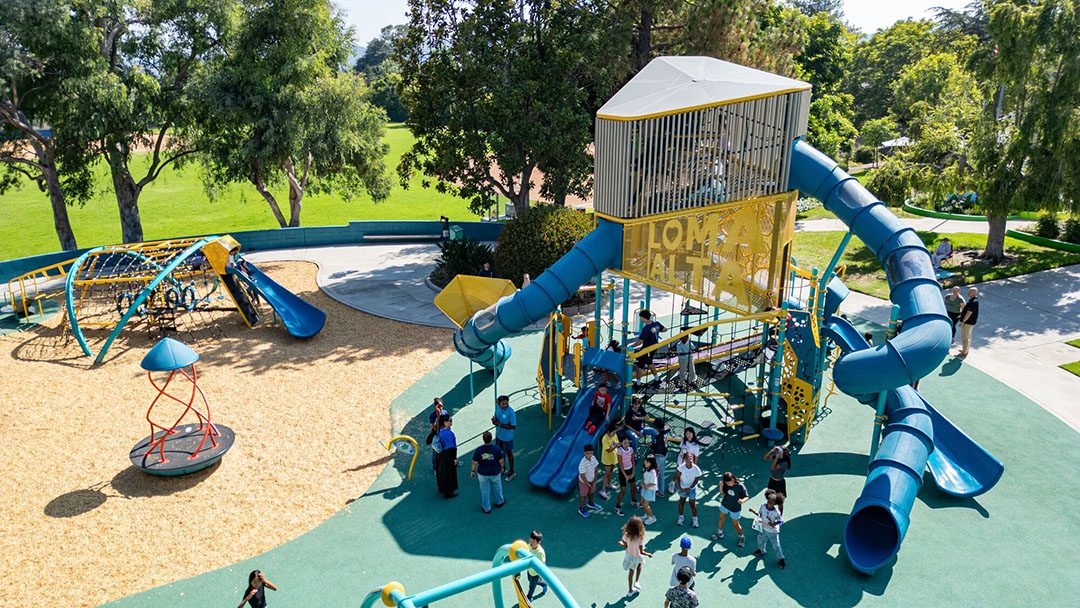
Loma Alta Park, Altadena, CA
At North Charleston, a much-loved community area that had fallen into disrepair was replaced with the inclusive Park Circle Playground. About 500,000 people used the playground within its first year, and local businesses reported more customers because of the park. The park offers charging stations for accessibility devices and wheelchairs, and utilizes slides made of different materials that don’t generate static – thus making them friendlier for children with cochlear and other medical implants.
Park Circle’s sensory dome and tunnel “that looks like a kaleidoscope inside,” in Moore’s words, is among “a ton of activities you can participate in without having to transfer out of a wheelchair.” There are climbing opportunities for people of all abilities, plenty of shade, and soft ground surfaces, “all woven into the space.”
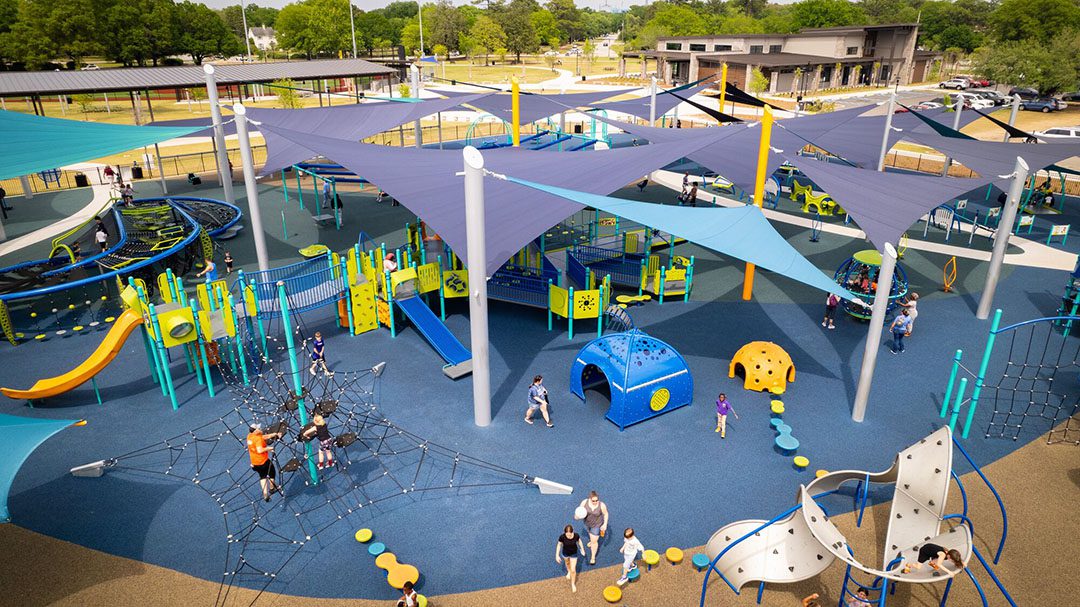
Park Circle Playground, North Charleston, SC
Renovating or building an inclusive playground can seem a daunting task for city planners and developers. Experts advise taking it slowly, listening to community input, and being transparent about the costs and options. Even if it’s not possible to realize everything parents want, making them feel heard goes a long way, Mansholt notes. Funding can come from sources like foundations, companies, and donors like the Minnesota soccer club. Boosters can even do creative fundraisers, such as collecting small donations for having kids paint tiles for the park.
Ultimately a new, inclusive park will pay off, in the experiences it provides for families and the way it can bring a neighborhood together.
“Every community defines inclusive parks a little differently. It’s this moving target that can be whatever we make it,” says Moore. “At the end of the day, the goal is to provide a just-right fit for everybody.”
The City Parks Alliance blog on Inclusive Play was written by Kari Lydersen. Kari is an assistant professor of journalism at Northwestern University and a Chicago-based journalist and author.